
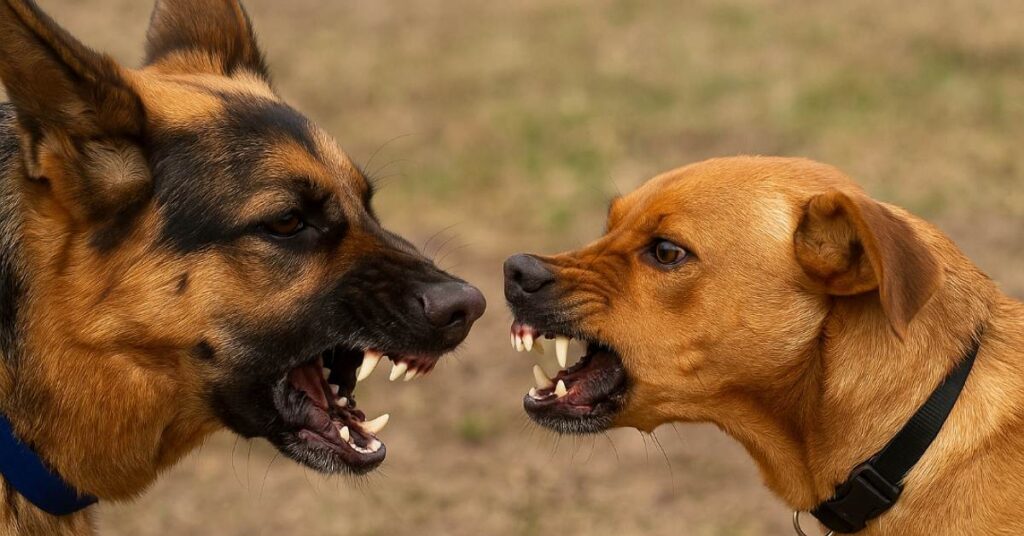
3. Avoid Punishment-Based Training
Many owners think that yelling, jerking the leash, or even hitting a dog will “fix” aggression. In reality, punishment often makes things worse.
Why Punishment Backfires
- It increases fear and anxiety, making your dog feel more threatened.
- It teaches your dog to distrust you, damaging the bond you’re trying to build.
- It suppresses the warning signs, which can lead to sudden, unpredictable bites.
Instead of punishing aggression, you need to teach calm behavior.
Use Positive Reinforcement
Reward your dog every time they make the right choice. Here’s how:
- Step 1: When your dog looks at another dog but doesn’t react aggressively, give a treat or toy.
- Step 2: Mark the behavior with a happy word like “Yes!” or use a clicker.
- Step 3: Repeat this consistently so your dog begins to associate other dogs with good experiences.
Over time, your dog learns: “Staying calm = rewards.”
4. Desensitization and Counter-Conditioning
If you want long-term success, you’ll need more than quick fixes. Two of the most effective methods for reducing aggression are desensitization and counter-conditioning. These are the same techniques used by certified dog trainers and behaviorists.
- Desensitization: This means slowly and safely exposing your dog to other dogs at a distance where they still feel comfortable. Over time, you reduce the distance as your dog learns to stay calm. Example: If your dog barks when another dog is 20 feet away, start training at 40 feet.
- Counter-Conditioning: Here, you change your dog’s emotional response to seeing another dog. Instead of fear or frustration, your dog begins to expect something positive—like food or play.
How to Do It Step by Step:
- Step 1: Begin far away from another dog.
- Step 2: The moment your dog notices the other dog and stays calm, give a treat.
- Step 3: Repeat this across multiple sessions. Slowly decrease the distance only when your dog consistently remains relaxed.
Important: This is a gradual process. Don’t rush it. For some dogs, progress may take weeks or even months.
5. Hire a Certified Dog Trainer or Behaviorist
If your dog’s aggression has reached a serious level—growling, lunging, snapping, or biting—it’s time to bring in professional help. Trying to handle severe aggression on your own can be dangerous for you, your dog, and others.
When to Seek Professional Help
- Your dog’s aggression is frequent and intense.
- Aggression happens toward family members as well as other dogs.
- You’ve tried training at home but see no improvement.
- The aggression feels unpredictable or escalates quickly.
Who Can Help
- Certified Professional Dog Trainer (CPDT-KA):
These trainers use positive, science-based methods to teach your dog safer behavior.
- Veterinary Behaviorist:
For complex cases, especially when medication may be necessary, a veterinary behaviorist is the best option. They combine medical knowledge with behavior training.
- Trusted Resources:
A great starting point is the International Association of Animal Behavior Consultants: IAABC.org. You can search for certified professionals in your area.
6 Comments
Thanks you
Yes
Wow
Cool
Thank you
Gracias